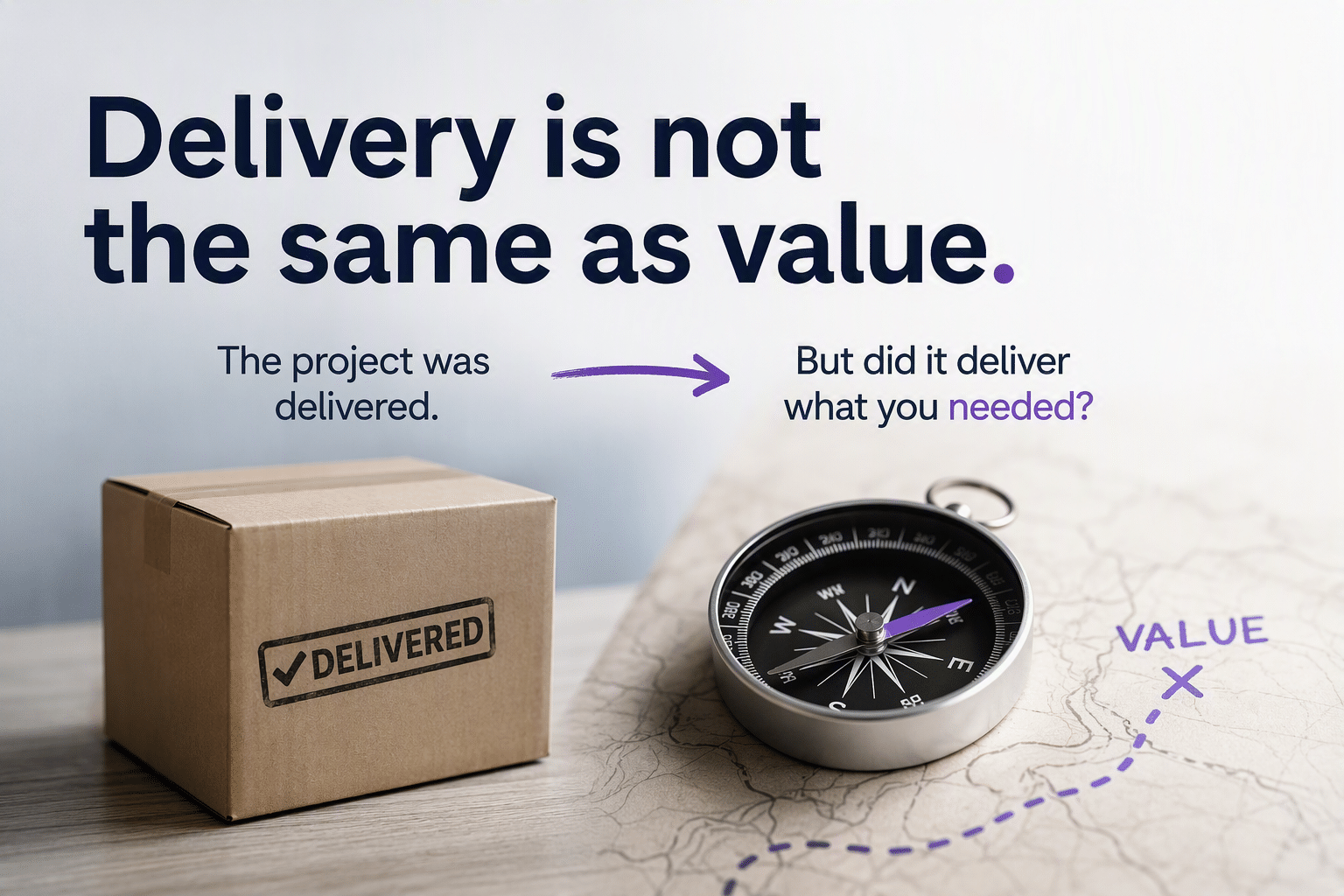
Why a project can go perfectly and still fail to deliver the value you needed. And what changes when someone owns that question.
Somewhere in most organisations there is a list. It might be a spreadsheet, a slide, or notes from a meeting. It’s the list of things the business plans to do next. At some point, that list becomes a plan. Budgets get attached. Projects begin.
Before any of that happens, there’s a question worth asking: what will those decisions actually be based on?
In my experience, the answer is rarely value. Projects are usually selected on cost, because that number is visible to everyone. Or on urgency, for example a licence is running out or a supplier is pulling support. Or on who argued for it the loudest. Or on what was promised last year and never happened.
These are all real reasons. But none of them tells you which project will actually create the most value.
Capability is not value
I once delivered a system migration for a client. It was on time, on budget, and did everything we’d agreed. By any normal measure, it was a success.
A year later, I rang to see how it was bedding in. Some of their people had gone back to using spreadsheets.
Not out of stubbornness. The system worked well, and staff liked it. But the part that was meant to deliver most of the value, a second phase of work, had never been built. It turned out to be harder to set up than expected. Once the first phase was live, the deadline pressure disappeared. Everyone went back to their day jobs. And there’s always something more urgent than a plan nobody’s chasing.
This isn’t a story about a bad decision. It’s a capable organisation making sensible choices at every step, and still ending up somewhere it didn’t mean to be. It happens more often than most of us admit.
The lesson is simple. Technology creates the opportunity. People create the value. A system can go live exactly as planned and still fail to deliver what it was meant to deliver. Capability and value are not the same thing. Capability only turns into value when people change how they work, when processes get redesigned around what’s now possible, and when someone ensures that it actually happens.
Why two firms buying the same software get different results
Take two organisations that buy the same software. Same vendor, same modules, similar budgets, similar size. Eighteen months later, one loves it. It’s changed how they run the business. The other is wondering if they picked the wrong product.
The reason is almost never the technology. It’s rarely the implementation partner. It’s hardly ever the method. The real difference is this: in one organisation, someone owned the question of whether the investment was delivering value. In the other, nobody did. That question sat between the project team, who got measured on delivery, and the business, who were busy running the business. So it belonged to no one.
I saw this happen with a firm that replaced its billing system. The goal was simple: invoices were going out late, and the finance team was drowning in corrections. The new system fixed both. By any normal measure, the project was a success.
What happened next is the interesting part. The new system could do things the old one never could. Someone noticed. The process got redesigned around it. A lot of time and friction disappeared, none of which was in the original business case. The software created the opportunity. Someone had to spot it and act on it.
That didn’t happen by luck. Someone kept asking three questions. They come from a framework called BVMF® (the Business Value Maximisation Framework), built by David P Jacobs. It calls this discipline Assess, Boost, Check (ABC):
- Assess: Where does the value actually come from? Not the benefits in the business case, but the real, specific changes in how people will work.
- Boost: Once you know where the value comes from, look for ways to get more of it. Not more scope. Not more spend. Just more value from what you’ve already got.
- Check: After go-live, go back and ask if the value is actually showing up. Then do it again three months later. And again after that.
You can start ABC at any point. Before a project begins, is best because you can build out the value as you deliver.
You can also start halfway through the project and prevent the value leaking away as decisions are made to reduce scope or mitigate the almost inevitable time/budget overruns
Or you can start right now, with a process that’s been running for years with no project in sight.
The earlier you start, the more it shapes your decisions, adding value instead of just measuring it after the fact.
Choosing well, before anything is committed
All of this matters most before a single project starts, while the list is still just a list.
A value-led plan starts with a different question. Not “what do we need to do next?” But “where’s the biggest value, and what’s the shortest way to get it?”
For each project on the list, ask where the value comes from. For it to show up, identify who needs to work differently. Be honest about the factors that drive value. Some benefits depend on the system. Others depend on people changing how they work. Compare projects by the value they’ll create, not by cost.
Sometimes it means saying no to something on the list. That’s often the best decision you can make. Every organisation has more ideas than it has capacity. Choosing well is the point.
A small process change with a clear line to revenue can easily beat a big system replacement that looks impressive but depends on twenty things going right. Do this across your whole list, and it changes what gets approved. Do it early enough, and it changes how each project gets shaped in the first place. Value you define before the scope is locked in tends to survive. Value that only lives in a business case usually doesn’t. The focus value should guide your decisions from the outset.
The question worth asking
Whatever list your organisation is working from, or about to build, it’s worth asking one plain question. Does anyone own this: is it delivering what it should, and could it be delivering more?
Most organisations are pretty good at managing delivery: schedule, budget, scope. Far fewer are good at managing value, especially once a project has closed and everyone’s attention has moved on. That gap, between what technology makes possible and what a business actually does with it, is where the biggest, most avoidable losses tend to sit.
If you’d like to talk through where that gap might be sitting in your own organisation, I’m always happy to have that conversation. Use the Contact Form, or book a free 30min call directly using my Calendly link.