

One of the quieter truths of project and change management is this:
projects rarely fail because the plan was wrong – they fail because people were not managed well.
You can have a strong business case, a detailed delivery plan and capable people doing the work, and still struggle to land the outcome. In my experience, the difference between success and failure often comes down to how well stakeholders are understood, engaged and managed over time.
I have written previously about responsibility and accountability, and how tools like RACI bring clarity to delivery. Stakeholder management is the natural companion to that thinking. RACI tells you who does what. Stakeholder management helps you understand who really matters, how they feel, and how you need to work with them to succeed.
Stakeholder management Is inherently sensitive
Stakeholder management is not a mechanical exercise. By its very nature, it is judgemental.
You are forming views about colleagues:
- how much influence they really have
- how they are likely to react to the change
- whether they will support it, tolerate it, or resist it
Because of this, stakeholder analysis should never be done casually or publicly.
In practice, I have found it works best when it is carried out by the project, programme or change manager with a small group of trusted individuals who are fully committed to the success of the initiative. This might include a sponsor, a senior delivery lead, or someone with deep organisational insight.
The outputs are confidential. They exist to help the project manager think clearly and act deliberately. They do not belong in a shared project folder, and they should certainly not appear as a slide in a Steering Committee pack.
Identifying stakeholders properly
A stakeholder is anyone who can influence the project, is impacted by it, or believes they are impacted by it. That last point is critical.
Stakeholders are not limited to:
- the project board
- senior sponsors
- named workstream leads
They also include managers, specialists, and individuals who may feel threatened, overlooked, or unconvinced. Perceived impact often drives behaviour more strongly than actual impact.
Effective stakeholder management starts with explicit identification, both of individuals and groups, before any engagement strategy is defined.
Power and interest: simple, YET still effective
Once stakeholders are identified, the next step is analysis.
The most widely used and still one of the most effective approaches is to assess stakeholders based on:
- Power or influence within the organisation
- Interest in the success of the project
Power and interest are often visualised using a simple 2 × 2 grid. The value is not the labels themselves, but the discipline it creates in deciding where limited time and attention should be focused.
- Low power / low interest – minimal effort
- Low power / high interest – keep informed
- High power / low interest – keep satisfied
- High power / high interest – manage closely
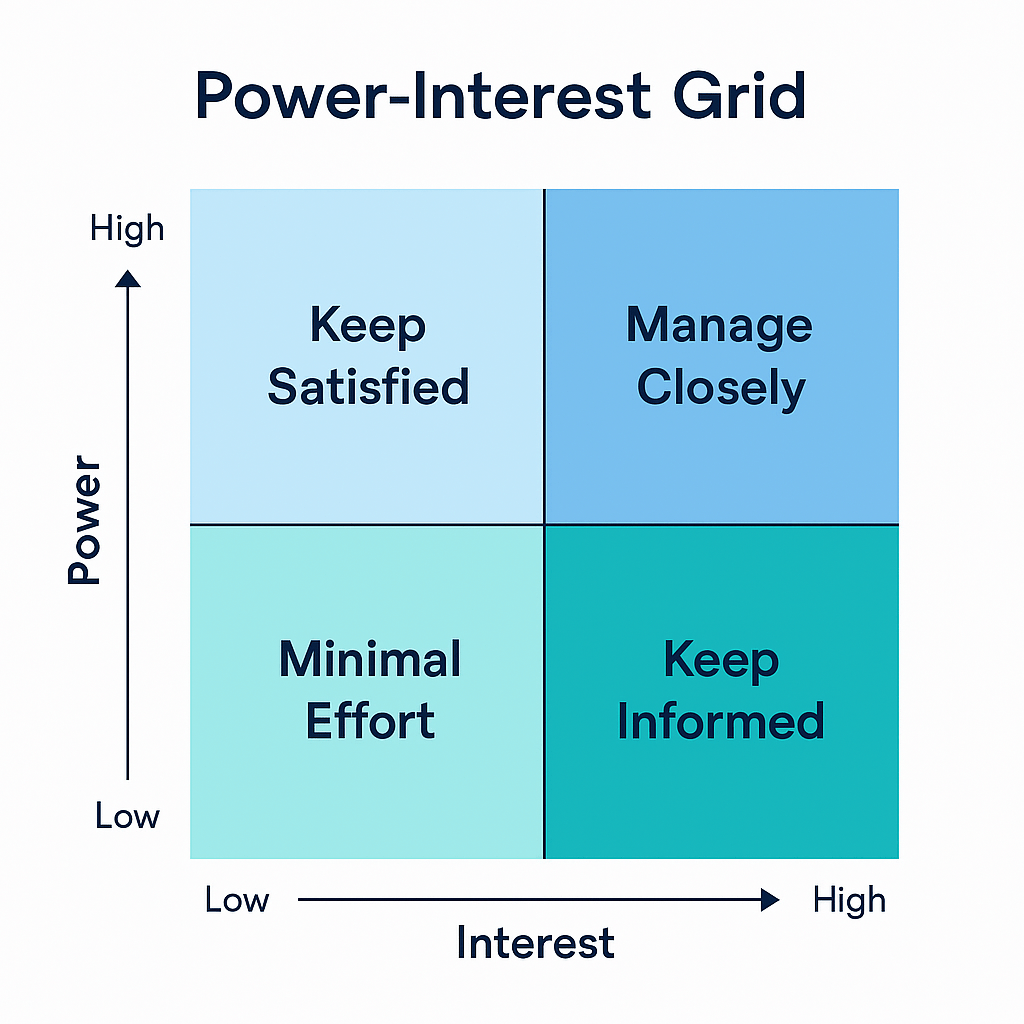
The value of the grid is not the labels themselves, but the discipline it creates. It forces you to be honest about where attention is really required.
Interest does not mean support
One of the most common mistakes is assuming that high interest automatically means positive engagement.
In reality, stakeholders may be:
- enthusiastic supporters
- passive followers
- active opponents
A stakeholder with high power and high interest who is sceptical or opposed represents a very different challenge from one who is fully supportive. Understanding reaction and desired support is just as important as understanding power.
From analysis to tailored communication
Project communication is never one‑size‑fits‑all.
The purpose of stakeholder analysis is to help answer a very practical question:
what is the right message, for the right person, at the right time?
For some stakeholders, that might mean:
- a monthly written update
- a personal email summarising progress
- a link to a project site or shared document
For others — particularly those in the high power / high interest quadrant — this is often not enough. Face‑to‑face briefings, informal conversations, and early sight of emerging issues may be essential.
You cannot do this for everyone, and you should not try. Stakeholder analysis gives you permission to be selective and intentional.
Linking stakeholder management with RACI
This is why I often combine stakeholder analysis with a RACI model.
RACI provides clarity on:
- who is Responsible for delivery
- who is Accountable for outcomes
- who must be Consulted
- who needs to be Informed
When viewed alongside stakeholder power and interest, it often highlights risks that would otherwise remain hidden. For example:
- a stakeholder marked as Consulted but with significant influence and low support
- an Accountable owner who is disengaged from day‑to‑day progress
- an enthusiastic stakeholder with little formal responsibility who could act as an advocate
These insights allow the project manager to intervene early rather than react later.
A practical template for real projects
To support this in practice, I have created a combined RACI & Stakeholder Management template, which I use regularly with clients.
The template helps to:
- identify stakeholders by name and role
- assess power, impact, reaction and desired support
- group stakeholders using the power / interest model
- define appropriate communication approaches
- keep stakeholder risk visible as projects evolve
Stakeholder management is not a one‑off task. It needs to be revisited as projects progress, people change roles, and organisational dynamics shift.
You can download the template here as a free resource:
Stakeholder management is a leadership discipline
At its heart, stakeholder management is not about tools or templates. It is about leadership.
It requires:
- judgement and discretion
- curiosity about how others see the change
- willingness to listen, not just broadcast
- consistency in engagement, especially when things get difficult
Projects succeed when the right people feel informed, respected and involved in the right way. Stakeholder management is how you make that happen.
A note on sensitivity and when external support helps
Stakeholder analysis is one of the most valuable tools in change management, but it is also one of the most sensitive.
You are forming opinions about colleagues, influence, motivations and likely behaviours. Done badly, this can damage trust. Done well, it becomes a quiet but powerful enabler of successful change.
For that reason, I often recommend that stakeholder analysis, particularly for complex or politically charged initiatives, is facilitated by an independent external party.
An experienced external facilitator can:
- create a safe, confidential space for honest discussion
- surface unspoken risks that internal teams may avoid naming
- challenge assumptions without organisational baggage
- help translate judgement into practical engagement strategies
The output remains confidential. It exists to support the project manager and sponsor, not as a document to be shared or presented.
This is exactly the type of work I support organisations with: helping leadership teams understand their stakeholder landscape clearly, discreetly, and pragmatically so that change has the best possible chance of landing well.
If you’d like to discuss how this might help your next project or programme, I’m always happy to have an initial conversation. Here’s my booking link to arrange a call.



Leave a Reply